
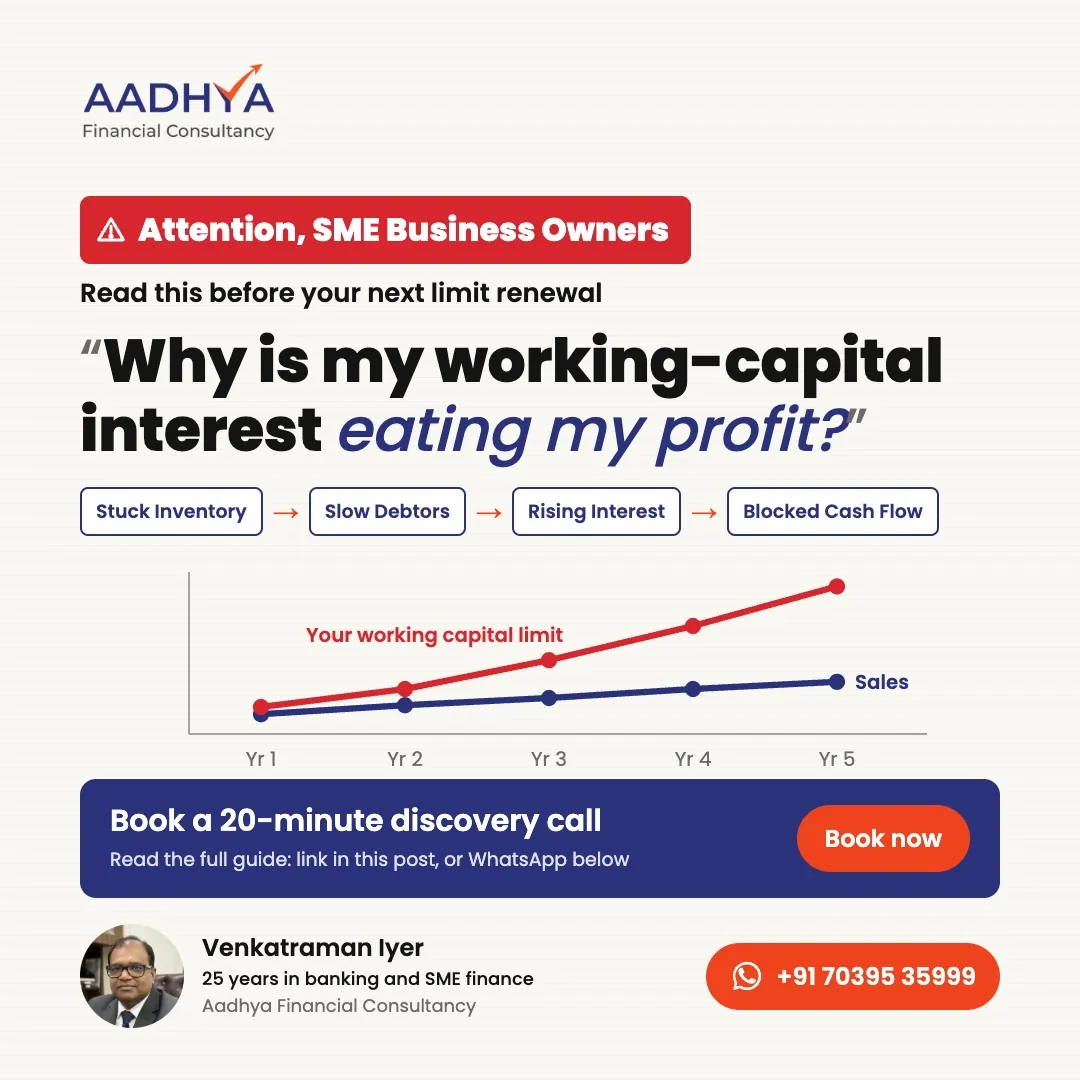
It is the question I hear from SME owners more than any other. Sales have grown a little over five years. The bank's working capital limit has grown a lot more. The interest bill has grown with the limit. And the owner cannot say where the money went, because the business is profitable on paper.
In 25 years of reading SME balance sheets, most of them from the bank's side of the table, I have seen the same thing behind that question again and again. It is not a bad bank, and it is not a bad business. It is a working capital limit that has quietly started doing a job it was never meant to do.
What a working capital limit is meant to fund
A cash credit (CC) or overdraft (OD) limit exists to fill one gap: the time between paying for stock and collecting from customers. You buy raw material, you make or trade the goods, you sell on credit, and the customer pays after 30, 60 or 90 days. Working capital finance funds that cycle.
So the bank lends against two things: stock that is moving, and receivables that will be collected. That is what the drawing power calculation on your monthly stock statement is for.
What the bank does not fund
The bank does not fund stock that has stopped moving, and it does not fund a debtor who has stopped paying. Every lender knows this. The stock and book-debts statement has a column for non-moving inventory, and most banks exclude debtors older than 90 days from drawing power. Dead stock and overdue debtors are, in the bank's eyes, not working capital at all.
Here is the part that matters. In the owner's own books, that stock is often still shown at cost, and that debtor is still shown as good. Nobody wants to write off a loss. So the old stock and the old debtor stay on the balance sheet year after year, and the limit gets renewed year after year.
The loss never leaves. It just gets financed again, and you pay working capital interest on it every quarter.
The chain: stuck inventory, slow debtors, rising interest, blocked cash flow
That is the whole story in four steps.
- Stuck inventory ties up part of the limit.
- Slow debtors tie up more of it.
- The limit is now full, so interest is at its maximum every month.
- Because the limit is full, there is no room to fund the next real order, so cash flow is blocked even though the business is profitable.
Owners feel the last step first: "I have a limit of two crore and I still cannot pay my supplier on time." That is the symptom. The cause is three steps back.
An illustration with round numbers
Take a trading business with a working capital limit of Rs 2 crore at 10% a year, so Rs 20 lakh of interest a year. Suppose Rs 60 lakh of the stock in the books has not moved in eighteen months, and Rs 40 lakh of debtors are more than a year old.
That is Rs 1 crore of the limit carrying things that will not turn into cash: Rs 10 lakh a year of interest on money that is not working. Over five years, Rs 50 lakh paid out of profit to carry a loss the business has not admitted to itself.
These figures are an illustration only, not a quotation or a typical result. Every business is different. The shape, in my experience, is usually the same.
Three signs to check before your next limit renewal
- Your limit has grown faster than your sales. Compare the sanctioned limit and the turnover for the last five years. If the limit has doubled and sales are up thirty percent, ask where the rest went.
- The same stock and the same debtors appear in every stock statement. Put last year's stock statement next to last month's. The names that appear in both are the ones to look at.
- The limit is always full. A CC limit that is fully utilised, ninety percent or more every month, regardless of season, is no longer working capital. It is behaving like a term loan with no repayment schedule, at working capital rates.
Why a limit enhancement usually makes it worse
The usual answer is to ask the bank for an enhancement. A bigger limit feels like relief. But if the old stock and the old debtors are still in the books, the bigger limit carries them too, and the interest on the old loss compounds faster. Compounding, as the saying goes, is the eighth wonder of the world. It works against you exactly as well as it works for you.
The better route is to show the bank the full picture early. A clear plan for old stock and slow debtors reads far better to a lender than a limit that keeps growing.
What actually works: how to reduce working capital interest
Old stock and dead debtors are not working capital. They are a one-time loss, and a one-time loss is best carried by long-term money that is repaid in planned instalments, for example a working capital term loan (WCTL) where a lender agrees to one, so that the CC limit goes back to doing its real job. How that is structured depends on the business, the lender's assessment and the balance sheet, and it is a conversation, not a blog post.
The first step is smaller than that. It is twenty minutes with the last three years of balance sheets and the last twelve stock statements, to find out which side of the line your business is on. Most owners have never looked at their own limit this way, because nobody on their side of the table was reading it the way the bank does.
Frequently asked questions
Why does my working capital limit keep increasing while sales stay flat?
Usually because part of the limit is carrying stock that has stopped moving or debtors who have stopped paying. Those items stay in the books as current assets, the limit is renewed against them, and the limit grows without the sales to justify it.
How is interest calculated on a CC limit, and does the bank charge interest on stuck inventory?
Interest on a cash credit account is charged on the daily drawn balance, not on the sanctioned limit. If the drawn amount is being used to carry old stock and old debtors, then yes, you are paying working capital interest on assets that are not producing cash.
Should I ask for a limit enhancement if my working capital is always full?
Not before checking what the current limit is carrying. If old losses are inside it, an enhancement carries them too and raises the interest cost further.
Can a CC limit be converted into a term loan?
Sometimes. Where a lender agrees, part of a working capital limit that is carrying old losses can be carved out into a working capital term loan with fixed instalments. Whether that is available, and on what terms, depends entirely on the lender's assessment of the business.
What is the difference between working capital and loss funding?
Working capital funds the gap between buying stock and collecting from customers. Loss funding is what happens when the same limit is used to carry stock and debtors that will never turn into cash. The first is temporary and self-liquidating; the second is permanent until it is recognised and refinanced properly.
Do it yourself, or have me by your side
You can check the three signs above yourself, against your last three balance sheets and stock statements. To score your whole file the way a credit officer would, use the free Lender's View Self-Check: ten Yes or No questions and your score in 10 minutes.
Or I can read your balance sheet with you, find what your limit is really carrying, and take the right structure only to the lenders keen on a business like yours.
A 20-minute Lender's View call
If your limit has gone up faster than your sales, that is what the call is for. No documents needed for the first conversation. We look at whether your limit is funding your business or quietly carrying old losses, and what your options may be.
Book here: Book a 20-minute Lender's View call on WhatsApp. The message is already typed for you; just press Send.
Or call / WhatsApp: +91 70395 35999.
Venkatraman Iyer is the Founder & Partner of Aadhya Financial Consultancy, Thane, with 25 years in banking and SME finance. Aadhya is a loan advisory, loan DSA and loan syndication firm working with MSME owners on working capital, term loans and business loans through banks and NBFCs.
Disclaimer: This article is for general information and education only and is not financial, legal, tax or investment advice. Aadhya Financial Consultancy is a loan advisory, loan DSA (direct selling agent) and loan syndication firm working with banks and NBFCs; it is not a bank or NBFC and does not lend. Any credit facility is subject to the lender's own assessment, terms, and approval, and interest rates, limits and structures vary by lender and borrower. Figures used above are illustrations only. Please consult your chartered accountant and your lender before acting on anything here.

I spent 15 years inside banks learning how a lender reads a loan. Since 2017, I've used it only on the borrower's side.
More about me →